Uncategorized

Indie Review – Meta

51r3irvpbol-_sx311_bo1204203200_Meta is the debut novel of Tom Reynolds. Like my previous review, it too is a superhero novel, although this one skews much closer to its comic book roots. Keeping in the comic book tradition of alliterative names, it follows Connor Connelly, an orphan who gains a device that grants him superpowers. He’s the first person to have superpowers in years. But while trying to gain control of his powers, a new supervillain, the Controller, has been wreaking havoc. Inevitably, Connor has to stop him.

It is a quick, fun read. It is very much a young adult book, but that isn’t a bad thing. Some of my favorite books are YA.  Like most YA (thank you, Harry Potter), the main character is an average Joe who discovers that he’s ‘the superspecial person’ for an unexplained reason, but that’s nearly every superhero story. Heck, that’s Superman. The point of the story is how one deals with it (in addition to overcoming other challenges). There’s some great world building here, and you can tell the author is a big DC Comics fan, as there are numerous elements sprinkled throughout that comic book fans will recognize, but they’re thankfully not such blatant references that would leave those unfamiliar with them scratching their head. Speaking of DC Comic references, Midnight, a supporting character, is essentially an ersatz Batman, but it should be noted that he’s written like a good ersatz Batman. The main character comes across as a very green Robin, but that helps make him relatable. The main character here seems overpowered, but it is due to the strength of the writing that he is still challenged. It comes across, at times, like a story about what if Robin had superman’s powers (which interestingly was an actual story arc published by DC Comics last year). There’s some great wish-fulfillment stuff in there, and not since Robert Luis Stevenson’s Bottle Imp had I read about a fictional object that I wished I could have. I found my mind wandering, thinking about how I would handle it. Another fantastic aspect to the book, is that it doesn’t answer all the questions. It knows just which ones to answer to give you a satisfying ending, but leaves open just enough to make you want to come back for more. As for the writing, while not the best, it was clear and concise. It wasn’t a masterpiece, but it wasn’t trying to be. It got the point, story, and emotion across, and that’s what’s important.

The book is not without its flaws. Conner seems a little underdeveloped, but that seems to be done with the intention of allowing the audience to see themselves as the main character. Being a story about a high school aged superhero, it seems like a missed opportunity not to have the story actually take place in high school. Rather than on summer vacation. The average teenager’s life revolves around high school, and it just seems strange not to have it take place there. As a result, the best friend and love interest seems to come and go, not seeming as constant as they would be in a teenager’s life. It seems the only reason for not taking place during the school year was to set up action pieces, some of which don’t make sense, particularly a scene at the beach that just feels so small time, it feels unbelievable that it would be a target, or that anyone else would consider it to be a target. The thing that annoyed me most of all, however, was the ending, which seems as though it is trying to come across as a clever twist, but due to the readers not having the information prior to that, or even a hint to it, the ending comes across as a deus ex machina type ending.

Ultimately, despite the books flaws, it was still a thoroughly enjoyable read. It isn’t the greatest novel, but it is a fun one. It took me back to when I was a kid, and it is exactly the kind of book I’d have eaten up then. I can see some adults not enjoying it, but if you’re a kid (or teen) at heart, it might pay to give it a shot. There are apparently two sequels, and I plan on picking them up sometime. I’m curious to see where it goes.

If you’ve read the story or have a suggestion of another book you’d want me to review, please mention it in the comments below.

A Spark Ignites – Cover

The cover for my upcoming novel, A Spark Ignites, has been posted in the book section of the website and below. The art was done by the incredibly talented Fabián Cobos.

ASparkIgnitesCoverLoRes

The novel is currently in the editing phase, and I hope to have it available for purchase sometime in March, preferably early in the month.

Continuity Errors

As a comic book fan, I’m no stranger to continuity errors. It’s something that’s inevitable when a product is made by numerous people, writers and artists alike, over a period of decades.  I accept that. But what really bugs me are continuity errors in books. I’m not talking about plot holes or the like, as those can always be explained away if you’re creative enough. No, I mean “wow, that totally contradicts what you just said” type of errors. Now, people are under the misconception that a book series is always written by one author. More often than not, however, that isn’t the case. Even going back to The Hardy Boys, most long-running book series are ghostwritten. And in such cases, book-to-book continuity errors can be excusable, if they were written by different authors.

In elementary school, Animorphs was one of my favorite book series. I simply couldn’t get enough of it. I even had the videogames. Even at that young age, I noticed continuity errors within the world of the books. It’s no secret that about half of the Animorphs book series was written by various different ghostwriters. However the first twenty-something were written by K.A. Applegate. She introduced a concept in the first book called “thought-speak,” however violated and rewrote the rules several times during the first few books. The last fifty or so books were consistent with one another, but you get the impression reading the first few books that they’re earlier drafts, as though the author herself wasn’t entirely sure of all the concepts yet, or how they worked. From what I heard though, when they rereleased the first few books a few years back, they fixed the continuity errors. So at least they acknowledged their mistake.

It’s one thing to have inconsistencies from book to book, because at least then, if you read only a single book, it will still make sense. The gravest of continuity errors is when same book contradicts itself later on. Years ago, at the recommendation of a friend, I read Pendragon Book One: The Merchant of Death. It was not a very good book. What bugged me the most, however, was when the book contradicted its own rules. At one point in the book, Bobby, the main character, travels to another dimension. The people in that dimension speak a language he cannot understand. While there, he meets “travelers” from yet another dimension, who explain to him that at the moment his brain can only comprehend the language of other travelers, but it will take time for the magic to fully take affect and allow him to understand the natural inhabitants. Later on in the book he confronts the villain, another traveler, who reveals that he was disguised as a natural inhabitant the whole time. Which would be fine, if Bobby hadn’t tried talking to the man earlier in the book and couldn’t understand him, while the other travelers he was with were able to. This wouldn’t be hard to explain away, of course, if the author explained that the villain had killed the original person after Bobby had met him and was impersonated him (he had shapeshifting powers). But now, the villain explicitly said that the original person who he was impersonating had died years ago. If that was the case, Bobby should have understood him right away, as he was a traveler, but he didn’t. (Like the continuity error in Animorphs, this was apparently also fixed later, in the graphic novel adaptation.) Now, perhaps this is a nitpick. Continuity errors often are. But they always take me out of the story.  If you’re going to publish a book, please have someone read it over specifically looking for continuity errors. It’s embarrassing.

Let me know of any book continuity errors you’ve noticed in the comments below. How much did it bother you?

Indie Review – Micro God

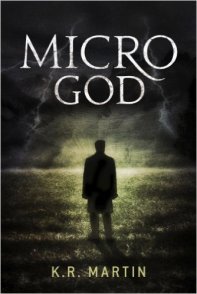
Micro God 51smbuqgxxl-_sx332_bo1204203200_is the debut novel of K.R. Martin. Honestly, calling it a novel is actually kind of misleading. It’s more of a short story or novella. It follows a man, Richard Clarke, who has the ability to control the reality directly around himself. Essentially, at least within his few surrounding feet, he is a god. A character like that is vastly overpowered, and it poses a challenge to write a character like that, at least if it went the typical superhero route. Thankfully it does not.

The story begins with Clarke finding himself disillusioned with humanity and life itself. It is a story of the pain and anguish immortality can bring. The horror of outliving everyone you’ve ever loved. Where he goes from there is something I won’t ruin for you, as I do not want to give anything away, but it isn’t exactly what you expect.

This story has a surprisingly original premise, with shades of Hancock and Lucifer. It asks what it would be like to be a god, and really explores the concept well, giving the reader a feeling of what it would be like to be an immortal with (nearly) limitless power. The execution is fantastic, for the most part (there are a few gang members who act and talk in a cliché manner that clashes with the otherworldly tone somewhat, and took me out of the story). There’s a romance element that can be a bit eye-rolling at times, but then again, most romance usually is. The writing was impressive for a first time author, and although there are a few minor mistakes, like a missing comma here and there (I’ve seen worse violations in traditionally published books), it doesn’t take away from the story. I’d be very interested in seeing more from this author at some point down the line. The book is currently only available in digital format, which given its size is not surprising. I would say it certainly worth picking up, especially considering it’s less than a dollar.

If you’ve read the story or have a suggestion of another book you’d want me to review, please mention it in the comments below.
Beginnings

I find that beginnings are always hard. Be it a first day of school, a first day at a new job, or starting a new project, there’s always this sense of anxiety. What if you can’t cut it? What if you fail? What if you get fired? What if you never finish? It can be overwhelming.

Yes, starting is always the toughest part, but once you get past that, you usually find that things flow. Several days in, you’ll find yourself wondering what you were ever so anxious about in the first place. Throughout my life, I’ve had many beginnings. The most anxious have probably been when I started driving, when I started college, my first date, and when I started working. (I’m lucky that marriage came relatively easy to me.) These universal firsts that everyone goes through eventually became the norm. I got used to driving, dating, college, and working. I could say that to an extent, I succeeded in those aspects. When it came to my own personal projects however, that was another matter entirely.

Ever since I was seven years old, I attempted to complete various different projects. I worked on my own comic books, video games, and animated shorts. While on the comic side, I finished several issues a year up until I turned thirteen or so (and proceeded to use the school’s copier to make copies, staple them, and sell them for 25 cents apiece), beyond that most of my projects ended in failure. None of the video games I attempted to make were ever completed. And during high school and college I attempted to make about six animated shorts, but only finished two of them. I worked on a (now defunct) webcomic for a few years, but never actually finished the last issue, leaving the story unresolved. I still have the last few pages, most of which are inked, sitting in a folder on my shelf. I keep telling myself I’ll finish it eventually, but I suspect I’m lying to myself. I’m not as proud of the story as I was when sixteen-year-old-me wrote it, or even when nineteen-year-old-me penciled and inked it. And so it will likely stay on my shelf, collecting dust, and perhaps I’ll show it to my children someday and lament of what might have been.

But failures are no reason to stop trying new projects. My problem, I realized, was that I tried making things that simply took too long to make, and it eventually burned me out. The only two animated shorts I ever finished were only around six minutes each and took me that many months, while I threw in the towel during the sixth month of production of my most ambitious twenty-two minute animated short after having a paltry thirty seconds (I had animated a single scene no less than 3 times from scratch, hoping to get it just right). So it made sense to me that my next project would have to me something that I would be able to finish in six months or less. Unfortunately, due to increased responsibilities and decreased time (the wife, school, work, etc.), I don’t have the same opportunities I had to create. That’s when I realized that there was something I could still do, so long as I had a laptop: Write a book.

I had several ideas for books, but I thought it’d be best to hit the ground running. So I dug out an old outline I had written some six years ago and began working on it from there. My only time to write was on the subway to and from work or school, assuming I was lucky enough to get a seat, but hey, people have done more with worse. Starting was certainly the most difficult part. The blank page staring back at you, begging to be filled, but you are unsure of just what to fill it with. Once I started, however, the rest of it (for the most part) flowed. I guess what could be taken from this is that you should just start. Stop putting off whatever it is you want to do. Just make sure you pick realistic goals for yourself first. Nearly four months later, I finished my first draft. There’s still much work to be done, but the end is actually in sight. I’m excited that soon I’ll be able to finally put another tally in the ‘completed’ column, and even more so, I’m excited to share it with all of you.

That brings us to this blog. Starting this wasn’t easy either. For weeks, I dragged my legs. But here it is, the first post. Will this blog catch on? Will anyone read it? Will I be able to stick with it, or will I give up six months later? I guess we’ll find out together.